How Businesses Can Minimize Costs from California's WAIRE Program
September 10, 2023
The Warehouse Actions and Investments to Reduce Emissions (WAIRE) Program was implemented on May 7, 2021 by the South Coast Air Quality Management District (AQMD) with the goal of reducing greenhouse gas emissions from warehouses across Southern California. Warehouse operators that fail to meet compliance may face steep fines, and meeting compliance through environmental initiatives may be costly.
This article examines how the WAIRE Program impacts warehouse operators and proposes methods of reducing the fines and costs associated with compliance.
What Is the WAIRE Program?
 The WAIRE Program, also known as Rule 2305, was adopted in May of 2021 with the intent to reduce emissions from warehouses and the goods transportation industry. Under the WAIRE Program, warehouses that operate within the South Coast Air Quality Management District (AQMD) in Southern California with at least 100,000 square feet of floor space in a single building must meet compliance and reporting standards set by the AQMD.
The WAIRE Program uses a point system known as the WAIRE Points Compliance Obligation (WPCO) that represents the number of points that warehouse operators must generate each compliance period to avoid fines, which can be over $350,000 per compliance period. The WPCO calculates a warehouse’s efforts to reduce its annual emissions and takes into account factors such as daily truck trips, weight and type of trucks entering and exiting the warehouse, energy usage, and schedule to phase in zero-emission vehicles (ZEVs).
WPCO is a menu-based point system that gives warehouse operators a variety of compliance options to pick and choose from. This system gives regulated warehouses flexibility in their compliance and allows them to choose the routes that work best for them; however, failure to meet compliance can result in substantial fines, but meeting compliance can result in hefty expenses.
Offsetting the Costs of the WAIRE Program
One of the most prominent and efficient methods of meeting compliance through the WAIRE program is to transition to electric and low-carbon vehicles. California’s Advanced Clean Fleets regulation requires all commercial trucks sold in California to be zero-emission by 2040, and phasing in ZEVs ahead of schedule can be one of the most efficient methods of accumulating WPCO points and avoiding fines.
Electric vehicles, particularly trucks, are more expensive than traditional internal combustion (ICE) vehicles. However, owning and operating electric trucks allows warehouse operators to lower their WAIRE fines, potentially earning long-term savings through avoided fees. EVs also meet the return on investment (ROI) much faster than ICE vehicles, with significant savings from reduced fines, lower fuel costs, and less maintenance.
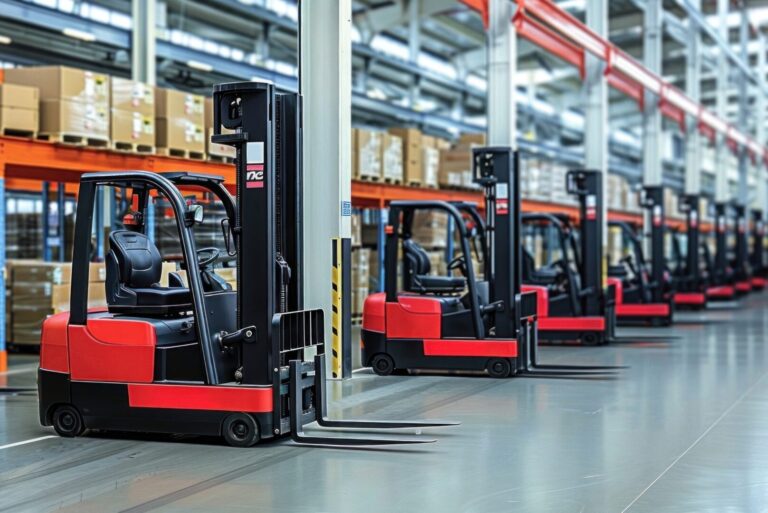
Warehouse operators can also reduce their WAIRE fines by switching to electric forklifts. While California’s ACT program currently doesn’t mandate the transition to electric off-road vehicles, warehouse operators can accumulate WPCO points by taking the initiative to transition their material handling equipment (MHE). Electric forklifts are growing in popularity, with warehouse operators and fleet owners reducing operation costs through electric forklifts, which require less maintenance and fuel costs. In addition, warehouse operators can earn cash rebates for their EVs, including trucks, forklifts, and other MHE, which can also help offset WAIRE fines.
As California transitions to a cleaner transportation sector, the California Air Resources Board (CARB) is offering rebates to owners of EVs for their reduced emissions. The Low Carbon Fuels Program (LCFS) encourages fleet owners and warehouse operators to transition to electric and low-carbon vehicles ahead of the ACT schedule and enables them to earn credits for every metric ton of carbon offset through the use of EVs. These credits can help substantially offset WAIRE fines through increased revenue as well as help EV owners meet their ROI significantly faster.
Smart Charging Technologies (SCT) can help warehouse operators manage, report, and resell their LCFS credits for the highest value and minimal hassle. SCT has relations with EV manufacturers across California, helping warehouse operators get in touch with manufacturers that will meet their specific needs.
Learn more about how SCT can help you offset WAIRE fines and get you in touch with EV manufacturing partners by contacting us today.
Related Posts
 Smart Charging Technologies Launches Smart Telemetrics Dashboard: A New Era of Simplicity in Motive Power Fleet Visibility
- Smart Charging Technologies to Unveil the Next Generation of Telematics System Solutions at ProMat 2025
- Maximizing Uptime on a Budget: Compete with Industry Leaders
- Finding the Right Fit: Essential Fleet Insights Without the Extras
- CARB Proposes Amendments to LCFS: How Changes Will Affect Fleet Owners
- One Year of Canada’s Clean Fuel Regulations: Impacts of the CFR
- One Year of the Clean Fuel Standard: Impacts of Washington’s CFS
- The Canada iZEV Program: Financial Incentives and Grant Opportunities for EV Fleet Owners
- Analyzing the Long-Term Effects of the Low Carbon Fuel Standard
- New Mexico Clean Fuel Standard Act Provides Opportunities for Owners of EV Charging Stations








About Us

SCT provides cost-effective telematics and remote power management solutions that optimize motive power fleet and self-service machine efficiency and reduce downtime with essential insights.
Share With Your Network
Popular Posts
Smart Charging Technologies Launches Smart Telemetrics Dashboard: A New Era of Simplicity in Motive Power Fleet Visibility
Orlando, FL – 4/15/25 — Smart Charging Technologies (SCT) is proud to announce the official launch of its Smart Telemetrics dashboard, a new centralized platform designed to give motive power fleet operators and dealers real-time visibility into their forklift, battery, and charger data—without the complexity or high cost of traditional systems. This new web-based dashboard…
 Katherine Perez
Smart Charging Technologies to Unveil the Next Generation of Telematics System Solutions at ProMat 2025
Smart Charging Technologies (SCT) is redefining motive power fleet telematics with cellular-powered tracking and monitoring solutions designed for efficiency without complexity. At ProMat 2025, SCT will debut its latest innovations, including IoTAh-PS, CHARGlink Light, CHARGlink BRM, BATTlink, and the Smart Telemetrics Cloud Platform, giving fleet operators, OEMs, and dealers the real-time insights they need—without costly…
Katherine Perez
Maximizing Uptime on a Budget: Compete with Industry Leaders
When you think of industry giants managing sprawling fleets with ease, it’s hard not to feel a bit daunted as a smaller operator. The big players have a clear edge with advanced forklift telematics systems tracking every move of their vehicles, monitoring battery performance, and streamlining energy use. But here’s the thing: telematics isn’t just…
Katherine Perez
Finding the Right Fit: Essential Fleet Insights Without the Extras
When it comes to choosing a telematics solution, it’s not about having the most features; it’s about having the right ones. For fleet operators, especially those managing smaller or mid-sized fleets, investing in a telematics system that truly fits their needs can make all the difference. While comprehensive fleet management systems offer a wide…
Katherine Perez
CARB Proposes Amendments to LCFS: How Changes Will Affect Fleet Owners
The California Air Resources Board (CARB) recently proposed several key changes to the Low Carbon Fuel Standard (LCFS) in an impact assessment report. The proposed amendments would increase the stringency of the LCFS and accelerate California’s push to carbon neutrality.This article provides an overview of the proposed amendments to the LCFS and explains how these…
 Impact Seo