January 3, 2024
Changes to Energy Rebate Reporting Requirements: California, Washington, and Oregon to Require Metering by 2024
In an effort to improve transparency and accuracy in credit generation, energy rebate programs along the West Coast will soon require metering for electric forklifts. These changes will go into effect as early as fall 2023 and will impact electric forklift owners who have previously used the calculated methodology to estimate their credit generation.
This article explains the changes that will be coming to energy rebate programs (also known as low carbon fuel programs) in California, Oregon, and Washington, and how EV fleet owners can prepare for the new reporting requirements.
Changes to Reporting Requirements For Electric Forklift
Energy rebate programs in California, Oregon, and Washington have previously allowed credit generators like electric vehicle (EV) fleet owners and owners of EV charging stations to report credits generated through electric forklifts via the calculated methodology. This method relied on calculated estimations based on forklift usage and approximated electricity consumption. However, changes to the energy rebate programs in these states will require credit generators to install meters that will report accurate real-time readings for electric forklifts.
Oregon Clean Fuels Program
Oregon’s Clean Fuels Program (CFP) allows owners of EV charging stations to earn credits based on their electric fuel consumption. The CFP is shifting away from the calculated methodology and phasing in metered requirements for electric forklifts as early as Q4 of 2023. The calculated methodology that avoids the use of meters for electric forklifts will still be allowed; however, the new calculation method will decrease the amount of electricity that can be reported — and by extension the amount of credits generated — by up to 80%.
Read more about the upcoming metering requirements in Oregon: Generating Credits with the Oregon Clean Fuels Program: Regulatory Updates for Electric Forklifts
California Low Carbon Fuel Standard
 California’s Low Carbon Fuel Standard (LCFS) will follow Oregon’s lead by requiring metered readings for forklifts that will ensure real-time accuracy. The LCFS will no longer allow the calculated methodology for electric forklifts and will require EV fleet owners to install meters that reflect actual metering at the point of dispensation. These changes are expected to be adopted in the fall of 2023 and go into full effect in early 2024.
Fleet owners can prepare by installing meters as soon as possible. Once the LCFS adopts these changes, fleet owners will no longer be able to generate credits without meters, potentially leading to fleet owners missing out on their credit earnings.
Washington Clean Fuel Standard
Washington’s Clean Fuel Standard (CFS) has mandated metered reading for forklifts as of Q2 of 2023. Installing meters to electric forklift charging stations can be a lengthy process, so the Washington Department of Ecology will allow estimated calculations for up to two quarters, so long as fleet owners can provide proof of plans to install meters. This will help alleviate the transition and minimize the likelihood that fleet owners will miss out on credit generation during the switch from the calculated methodology to metered readings.
Easing the Transition to Metered Readings
Installing meters to forklifts can be a complicated and expensive process for EV fleet owners. To ease this transition and ensure your fleet can continue generating credits from your electric forklifts, Smart Charging Technologies (SCT) has developed metering technology to help fit your fleet’s unique needs. When you partner with SCT to help you manage, report, and sell your energy rebate credits, you’ll have access to our metering tool that ensurea full compliance with your state’s energy rebate program. Our meters ensure that you don’t have to miss out on valuable credit generation when you make the switch to metering.
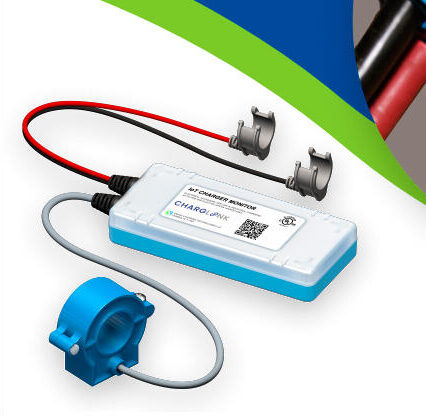 The Charglink meter is a cloud-based industrial charger monitoring and data logging system. With the Charglink meter, you’ll have access to:
- Both real-time and historical records of forklift charger usage, reported in kW and kWhr
- Charger fleet usage reports
- Remote monitoring and configuration, wirelessly transmitted to cloud-based servers
Charglink units are conveniently installed at the output terminals of industrial chargers, allowing for an easy transition to a metered system.
When you partner with SCT through our Smart Rebates program, you’ll not only have access to new metering systems that ensure compliance, but also an in-person audit to help you identify the best metering system for your facility.
As the adoption of metering becomes a widespread mandate, SCT's innovative solutions pave the way for seamless compliance with state requirements while offering valuable insights into energy consumption patterns. These metering platforms not only ensure accurate reporting and compliance with metering requirements but also enable fleet owners to maximize their credit generation through their state’s rebate programs.
Learn more about how partnering with SCT can help you optimize your earnings: 6 Reasons to Work with Smart Charging Technologies to Maximize Your Energy Rebate Credits
About Us

SCT provides cost-effective telematics and remote power management solutions that optimize motive power fleet and self-service machine efficiency and reduce downtime with essential insights.
Share With Your Network
Popular Posts
Mixed Fleet Telematics: Why Independent Visibility Wins
If Your Platform Only Sees Its Own Trucks, What’s Watching Everything Else?Walk onto most warehouse floors today and you won’t find a single-brand fleet. You’ll find a reach truck from one manufacturer next to a counterbalance from another, an order picker from a third, batteries from a couple different suppliers, and chargers that were installed…
 Katherine Perez
From Study to Savings: What Continuous Fleet Monitoring Actually Finds
The savings aren’t created by the monitoring. They’re revealed by it. Here’s what that looks like in practice — and why the findings consistently surprise even experienced fleet managers. WHAT MOST FLEETS DON’T KNOW THEY DON’T KNOWWalk into almost any warehouse or distribution center and you’ll find a fleet that’s being managed with reasonable care —…
Katherine Perez
Truklink™ Is Here
We talk a lot about clarity at Smart Charging Technologies. Clarity in your data. Clarity in your decisions. Clarity in what your fleet is actually telling you versus what you assumed it was. So it only made sense to apply that same standard to ourselves. Introducing Truklink™ and Truklink PS™ — the next evolution of…
Katherine Perez
What You Didn't Know About Your Fleet — And What You Can Do With It Now.
When continuous fleet monitoring surfaces something unexpected, the instinct is to question the data. Here’s why that moment is actually the most valuable one in the whole process. WHEN THE NUMBERS LOOK DIFFERENTThe monitoring devices have been running for a few weeks. The data is coming in. And some of it doesn’t match what you expected.A…
Katherine Perez
All-In-One Energy Metering Has Arrived — Introducing the IoTEmeter Series by Smart Charging Technologies
One device. Meter, enclosure, cellular connectivity, and a five-year LTE data plan — all included. Here’s what that means for your operation.Orlando, FL – 5/27/26 — Most energy metering solutions are sold in pieces. You buy the meter from one vendor, the enclosure from another, track down a cellular router separately, and then figure out…
Katherine Perez