January 9, 2026
Why Mixed Fleet Monitoring Breaks Down
If you’re supporting fleets today, chances are they didn’t choose to become mixed.
It just… happened.
- A new battery chemistry introduced to meet demand.
- A different charger deployed to solve a short-term problem.
- Incentive-driven upgrades layered onto legacy equipment.
None of these decisions were wrong. In fact, most were necessary.
What teams didn’t plan for was how quickly mixed fleet monitoring would become harder to manage — especially once different assets, locations, and technologies had to be tracked through disconnected fleet monitoring systems.
Most organizations don’t call this a problem right away.
They only feel it once visibility starts slipping.
What We’re Hearing in the Field
Across OEMs, dealers, and operators managing material handling fleets, the feedback is remarkably consistent:
- “We have data — just not all in one place.”
- “It works most of the time.”
- “We only notice gaps when something goes wrong.”
That’s not a failure of technology.
It’s a breakdown in industrial fleet visibility — caused by systems that were never designed to support mixed environments at scale.
The Real Issue with Traditional Fleet Monitoring
Most fleet telematics solutions were built around assumptions that no longer hold true:
- Stable networks
- Uniform equipment
- Single-user access
- Controlled environments
Mixed fleets challenge all of these assumptions.
Assets move between facilities.
Battery types vary.
Chargers change.
Users need different levels of access.
Add seasonal shifts — especially winter conditions — and weaknesses in fleet connectivity start to surface. Data becomes delayed or inconsistent. Dashboards still show activity, but confidence in the data erodes.
That’s when monitoring turns reactive.
Why More Tools Don’t Fix the Problem
When visibility breaks down, teams often respond by adding more monitoring tools.
Another portal.
Another report.
Another login.
But more tools don’t improve real-time fleet data — they fragment it.
The teams handling mixed fleets best aren’t watching more charts. They’re simplifying their telematics platform, reducing dependency on local infrastructure, and shifting focus from constant monitoring to exception-based insight.
This isn’t about collecting more data.
It’s about knowing when something actually needs attention.
Why SCT Built Its Solutions This Way
Before building telematics products, SCT spent years inside fleet data through incentive and rebate programs — analyzing deployments across batteries, chargers, and equipment.
What stood out was clear:
Fleet upgrades almost always outpaced visibility strategies.
Equipment changed faster than monitoring systems evolved.
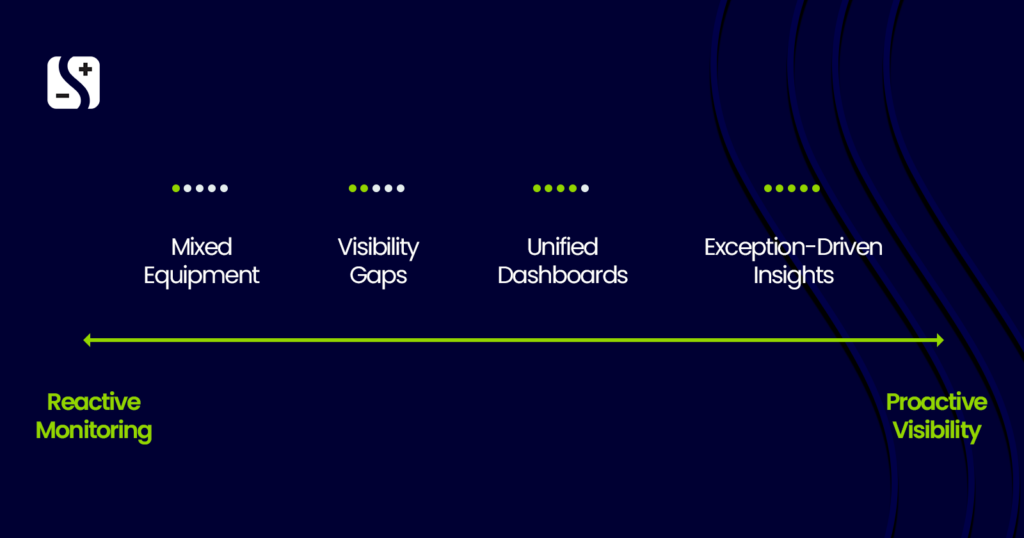
That gap shaped how SCT approaches battery and charger monitoring, connectivity, and dashboards — not as isolated tools, but as part of a unified system that has to work across mixed fleets, locations, and conditions.
What Actually Works in Mixed Fleets
The most effective mixed-fleet strategies share a few core principles:
- Cellular fleet connectivity treated as infrastructure, not convenience
- A centralized view across assets, even when fleets are distributed
- Focus on exceptions, not constant observation
- Controlled visibility for dealers, operators, and end users
- This approach doesn’t eliminate complexity. It absorbs it — and makes it manageable.
Closing
If your fleet grew organically, it’s worth asking:
Did your fleet monitoring strategy grow with it — or did it stay the same?
This is a conversation we’re seeing more often across industrial operations.
And it’s one worth having — before the next issue forces it.
Related Posts
 Why Most Motive Power Fleets Are Overbuilt — and Don’t Know It
- How One Tool Sparked SCT’s Telematics Platform
- Why Mixed Fleet Monitoring Breaks Down
- Smart Charging Technologies Unveils the New BATTlink: A Smarter, Slimmer and Simpler Way to Monitor Fleet Batteries
- Switch Always On Secures Patent for Breakthrough Power Management Technology
 Switch Always On Unveils SAO HP, a High-Voltage Remote Power Solution at InfoComm 2025
- Smart Charging Technologies Launches Smart Telemetrics Dashboard: A New Era of Simplicity in Motive Power Fleet Visibility
- Smart Charging Technologies to Unveil the Next Generation of Telematics System Solutions at ProMat 2025
- Maximizing Uptime on a Budget: Compete with Industry Leaders
- Finding the Right Fit: Essential Fleet Insights Without the Extras






About Us

SCT provides cost-effective telematics and remote power management solutions that optimize motive power fleet and self-service machine efficiency and reduce downtime with essential insights.
Share With Your Network
Popular Posts
Why Most Motive Power Fleets Are Overbuilt — and Don’t Know It
Are Electric Forklift Fleets Built for Peak Demand — or Daily Reality? Walk into almost any warehouse or distribution center and you’ll see a motive power fleet built for peak demand. Extra batteries.Extra chargers.Extra trucks. And in many cases, that configuration once made sense. But how often does your electric forklift fleet actually operate at peak demand? Across multiple deployments,…
 Katherine Perez
How One Tool Sparked SCT’s Telematics Platform
From Energy Data to Operational Intelligence: How One Tool Sparked SCT’s Telematics Platform Smart Charging Technologies didn’t start with the goal of building a telematics platform. We started with battery monitoring — because fleets needed a better way to understand how their most critical assets were actually being used day to day. As that work…
Katherine Perez
Why Mixed Fleet Monitoring Breaks Down
If you’re supporting fleets today, chances are they didn’t choose to become mixed.It just… happened.A new battery chemistry introduced to meet demand.A different charger deployed to solve a short-term problem.Incentive-driven upgrades layered onto legacy equipment.None of these decisions were wrong. In fact, most were necessary.What teams didn’t plan for was how quickly mixed fleet monitoring…
Katherine Perez
Smart Charging Technologies Unveils the New BATTlink: A Smarter, Slimmer and Simpler Way to Monitor Fleet Batteries
Orlando, FL – 12/16/25 — Smart Charging Technologies (SCT) announces the launch of its newest generation of BATTlink — a compact, cellular battery monitoring solution designed to transform how dealers, OEMs, and fleet operators manage battery health and performance.With a mission to eliminate guesswork from battery management, the redesigned BATTlink features a slimmer profile, our…
Katherine Perez
Switch Always On Secures Patent for Breakthrough Power Management Technology
Orlando, FL – July 15, 2025 — Switch Always On powered by Smart Charging Technologies LLC, a leading provider of remote power management and connectivity solutions, is proud to announce the issuance of U.S. Patent No. 12,355,243 titled: “Multiport Power Management System With Battery And Connectivity Backup Capabilities And Related Methods.” This patent recognizes the…
Katherine Perez