January 9, 2026
Why Mixed Fleet Monitoring Breaks Down
If you’re supporting fleets today, chances are they didn’t choose to become mixed.
It just… happened.
- A new battery chemistry introduced to meet demand.
- A different charger deployed to solve a short-term problem.
- Incentive-driven upgrades layered onto legacy equipment.
None of these decisions were wrong. In fact, most were necessary.
What teams didn’t plan for was how quickly mixed fleet monitoring would become harder to manage — especially once different assets, locations, and technologies had to be tracked through disconnected fleet monitoring systems.
Most organizations don’t call this a problem right away.
They only feel it once visibility starts slipping.
What We’re Hearing in the Field
Across OEMs, dealers, and operators managing material handling fleets, the feedback is remarkably consistent:
- “We have data — just not all in one place.”
- “It works most of the time.”
- “We only notice gaps when something goes wrong.”
That’s not a failure of technology.
It’s a breakdown in industrial fleet visibility — caused by systems that were never designed to support mixed environments at scale.
The Real Issue with Traditional Fleet Monitoring
Most fleet telematics solutions were built around assumptions that no longer hold true:
- Stable networks
- Uniform equipment
- Single-user access
- Controlled environments
Mixed fleets challenge all of these assumptions.
Assets move between facilities.
Battery types vary.
Chargers change.
Users need different levels of access.
Add seasonal shifts — especially winter conditions — and weaknesses in fleet connectivity start to surface. Data becomes delayed or inconsistent. Dashboards still show activity, but confidence in the data erodes.
That’s when monitoring turns reactive.
Why More Tools Don’t Fix the Problem
When visibility breaks down, teams often respond by adding more monitoring tools.
Another portal.
Another report.
Another login.
But more tools don’t improve real-time fleet data — they fragment it.
The teams handling mixed fleets best aren’t watching more charts. They’re simplifying their telematics platform, reducing dependency on local infrastructure, and shifting focus from constant monitoring to exception-based insight.
This isn’t about collecting more data.
It’s about knowing when something actually needs attention.
Why SCT Built Its Solutions This Way
Before building telematics products, SCT spent years inside fleet data through incentive and rebate programs — analyzing deployments across batteries, chargers, and equipment.
What stood out was clear:
Fleet upgrades almost always outpaced visibility strategies.
Equipment changed faster than monitoring systems evolved.
That gap shaped how SCT approaches battery and charger monitoring, connectivity, and dashboards — not as isolated tools, but as part of a unified system that has to work across mixed fleets, locations, and conditions.
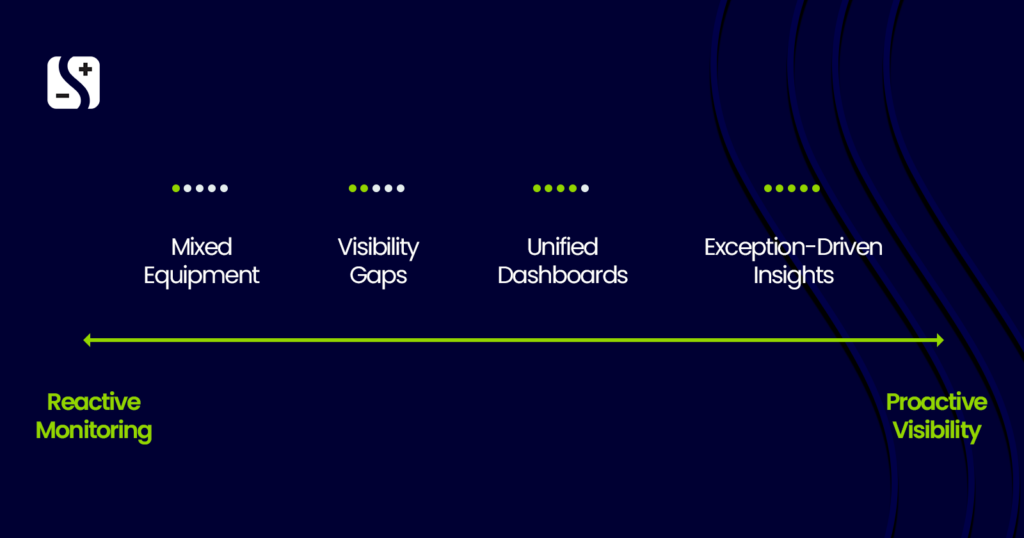
What Actually Works in Mixed Fleets
The most effective mixed-fleet strategies share a few core principles:
- Cellular fleet connectivity treated as infrastructure, not convenience
- A centralized view across assets, even when fleets are distributed
- Focus on exceptions, not constant observation
- Controlled visibility for dealers, operators, and end users
- This approach doesn’t eliminate complexity. It absorbs it — and makes it manageable.
Closing
If your fleet grew organically, it’s worth asking:
Did your fleet monitoring strategy grow with it — or did it stay the same?
This is a conversation we’re seeing more often across industrial operations.
And it’s one worth having — before the next issue forces it.
About Us

SCT provides cost-effective telematics and remote power management solutions that optimize motive power fleet and self-service machine efficiency and reduce downtime with essential insights.
Share With Your Network
Popular Posts
Retrofit Telematics: Add Visibility Without Replacing Equipment
Switching Platforms Shouldn’t Mean Replacing Equipment That Isn’t Broken There’s a quiet assumption built into a lot of telematics conversations: that better visibility means new equipment. New chargers, new batteries, a system torn out and swapped for another. For a lot of fleet managers, that assumption alone is enough to shelve the conversation entirely — the…
 Katherine Perez
Fleet Platform Lock-In: What It Costs You Later
Your Next Equipment Purchase Shouldn’t Be Limited by Which Platform You’re Locked Into Choosing a telematics platform can feel like a software decision. It isn’t, not really. It’s a bet on your future purchasing — a quiet agreement that whatever equipment brand that platform was built around is the brand you’ll keep buying, indefinitely.Most fleet managers…
Katherine Perez
Charger Intelligence: The Fleet Blind Spot No One Monitors
You Can See Your Trucks. You Can See Your Batteries. Who’s Watching Your Chargers? Ask a fleet manager what they track, and the answer usually comes fast: trucks, obviously. Batteries too, if they’ve been paying attention to run time and charge cycles. Then ask about chargers, and the pause says everything. Chargers are the one…
Katherine Perez
Mixed Fleet Telematics: Why Independent Visibility Wins
If Your Platform Only Sees Its Own Trucks, What’s Watching Everything Else?Walk onto most warehouse floors today and you won’t find a single-brand fleet. You’ll find a reach truck from one manufacturer next to a counterbalance from another, an order picker from a third, batteries from a couple different suppliers, and chargers that were installed…
Katherine Perez
From Study to Savings: What Continuous Fleet Monitoring Actually Finds
The savings aren’t created by the monitoring. They’re revealed by it. Here’s what that looks like in practice — and why the findings consistently surprise even experienced fleet managers. WHAT MOST FLEETS DON’T KNOW THEY DON’T KNOWWalk into almost any warehouse or distribution center and you’ll find a fleet that’s being managed with reasonable care —…
Katherine Perez